
La Galleria delle Applicazioni raccoglie un'ampia varietà di tutorial e di app dimostrative realizzati con COMSOL Multiphysics in diversi ambiti applicativi, inclusi quelli elettrico, meccanico, fluidico e chimico. E' possibile scaricare i file dei modelli e delle app demo pronti all'uso e le istruzioni step-by-step per costruirli, e utilizzarli come punto di partenza per le proprie simulazioni.
Lo strumento di Ricerca Rapida permette di trovare i modelli che si riferiscono alla propria area di interesse.
Si noti che molti degli esempi qui presentati sono accessibili anche tramite le Librerie delle Applicazioni incorporate nel software COMSOL Multiphysics® e disponibili dal menu File.

This tutorial model demonstrates the use of the Area Scaling Factor (ASF) in the Heat Transfer in Shells interface, to account for the curvature of the layers when applying heat fluxes and heat sources. The results obtained with the Heat Transfer in Shells interface applied to a ... Per saperne di più

This a continuation of the permanent magnet motor model available here . In this model, an heat transfer analysis has been performed to compute the temperature rise for various stator current and rotor speed. A detailed analysis on torque, and losses in iron and copper have then been ... Per saperne di più

High-power battery energy storage systems (BESS) are often equipped with liquid-cooling systems to remove the heat generated by the batteries during operation. This tutorial demonstrates how to define and solve a high-fidelity model of a liquid-cooled BESS pack which consists of 8 ... Per saperne di più

The Czochralski (CZ) method is one of the most important methods for the preparation of monocrystalline silicon. The shape of the crystal, especially the diameter, is controlled by carefully adjusting the heating power, the pulling rate, and the rotation rate of the crystal. This model ... Per saperne di più

This example uses the thermal expansion of a laminated composite shell model to demonstrate the use of the feature Thermal Contact, Interface, applied on interfaces between layers in a laminated composite shell. The first study is computed neglecting this additional thermal resistance in ... Per saperne di più

You can use assembly meshing to reduce the number of mesh elements in your model, which is especially useful for conjugate heat transfer simulation in cases where the fluid domains can be handled with swept mesh. These models demonstrate how to use form assembly and discontinuous meshes ... Per saperne di più

This model presents a way to compute projected area using the Surface-to-Surface Radiation interface of the Heat Transfer Module. By computing illuminated area from a set of directions on a discretized sphere, it is possible to interpolate the projected area onto any angle of incidence. ... Per saperne di più

This model demonstrates topology optimization of a 2D heat exchanger with laminar flow. The flow is pressure driven and the objective is to maximize the heat transfer. The density method is used with the (now) classical approach of a single design variable and two flow interfaces. ... Per saperne di più
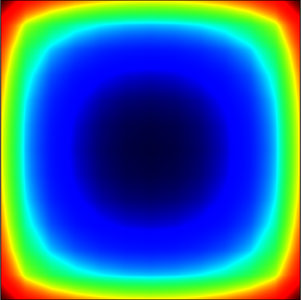
This model is used on "Heat Transfer with Radiation in Participating Media and the Discrete Ordinates Method" to compare quadrature sets used in the method of discrete ordinates. The reference analytical solution of incident irradiation is obtained with 256 discrete directions. Errors in ... Per saperne di più

A gray body with a spherical cavity with various opening areas is simulated using the Heat Transfer, Surface-to-Surface Radiation interface. The emissivity for each case is computed and compared with the classical gray body theory. The COMSOL Multiphysics® result agrees very ... Per saperne di più