
La Galleria delle Applicazioni raccoglie un'ampia varietà di tutorial e di app dimostrative realizzati con COMSOL Multiphysics in diversi ambiti applicativi, inclusi quelli elettrico, meccanico, fluidico e chimico. E' possibile scaricare i file dei modelli e delle app demo pronti all'uso e le istruzioni step-by-step per costruirli, e utilizzarli come punto di partenza per le proprie simulazioni.
Lo strumento di Ricerca Rapida permette di trovare i modelli che si riferiscono alla propria area di interesse.
Si noti che molti degli esempi qui presentati sono accessibili anche tramite le Librerie delle Applicazioni incorporate nel software COMSOL Multiphysics® e disponibili dal menu File.

A Butler matrix is a passive beamforming feed network. It is a cost-effective feed network for phased array antennas because the circuit can be fabricated in the form of microstrip lines and is a viable solution for performing beam scanning without deploying expensive active devices. ... Per saperne di più

An iron sphere in a magnetic field is an excellent textbook example to demonstrate the effects of a magnetic field interacting with a permeable material. This tutorial series is designed as an introduction to numerically modeling electromagnetic effects with COMSOL. This series ... Per saperne di più

This is a model of a MEMS microphone solved in the frequency domain including the DC prestress effects. The model is set up using the Electromechanics multiphysics interface, Thermoviscous Acoustics, and Pressure Acoustics. The microphone consists of a perforated plate and a prestressed ... Per saperne di più

In this model, we show how to model Seebeck effect which works as a thermoelectric generator. Seebeck effect is a phenomena where the difference in temperature of a material leads to a potential difference. The potential drawn in this model was compared with the paper by Jaegle (Example ... Per saperne di più

In its simplest form, an optical ring resonator consists of a straight waveguide and a ring waveguide. The waveguides are placed close to each other, making the light affect each between the two structures. If the propagation length around the ring is an integral number of wavelengths, ... Per saperne di più

This example calculates the spectral properties of a 3D optical ring resonator. The model demonstrates how to use parts from the Wave Optics Parts Library and how to setup the Field Continuity boundary condition at boundaries, where there is a jump in the predefined phase approximation. Per saperne di più
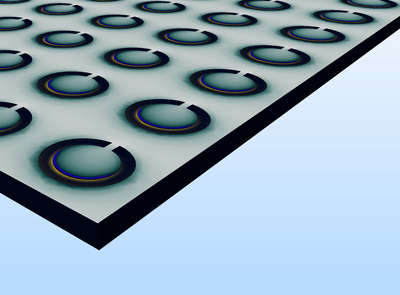
Frequency selective surfaces (FSS) are periodic structures with a bandpass or a bandstop frequency response. This model shows that only signals around the center frequency can pass through the periodic complementary split ring resonator layer. Per saperne di più
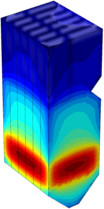
This model uses the discrete-ordinates method (DOM) to analyze the radiative heat transfer in a utility boiler with internal obstacles. DOM is one of the most useful radiation models for prediction of radiative heat fluxes on the furnace walls of a combustion chamber. With this model, ... Per saperne di più

This model solves the Boltzmann equation in the two-term approximation for a background of molecular and atomic hydrogen. Electron mobility and source terms are computed by suitable integration of the electron energy distribution function over electron impact cross sections. Per saperne di più

It is possible to realize a narrowband bandpass filter using cascaded microstrip coupled lines. In this example, a design composed of cascaded microstrip lines, each approximately a half wave length in size at the resonant frequency, is analyzed. The model is solved for the S-parameters ... Per saperne di più


