
La Galleria delle Applicazioni raccoglie un'ampia varietà di tutorial e di app dimostrative realizzati con COMSOL Multiphysics in diversi ambiti applicativi, inclusi quelli elettrico, meccanico, fluidico e chimico. E' possibile scaricare i file dei modelli e delle app demo pronti all'uso e le istruzioni step-by-step per costruirli, e utilizzarli come punto di partenza per le proprie simulazioni.
Lo strumento di Ricerca Rapida permette di trovare i modelli che si riferiscono alla propria area di interesse.
Si noti che molti degli esempi qui presentati sono accessibili anche tramite le Librerie delle Applicazioni incorporate nel software COMSOL Multiphysics® e disponibili dal menu File.

This example considers the natural convection of air above a smoldering incense stick. This kind of flow often shows a transition from laminar to turbulent which is nicely visualized by the smoke produced by the slow burning of the incense. The model uses the Nonisothermal Flow, LES RBVM ... Per saperne di più

This model analyzed the ALD deposition process of alumina film on the surface of a U-shaped structure. In this process, gaseous precursors are sequentially introduced to the reaction chamber and sequentially undergo a series of adsorption and chemical reactions on the surface. The ... Per saperne di più

In the semiconductor manufacturing process, photoresist coating is an important process and the thickness of the photoresist layer needs to be precisely controlled. Usually, the photoresist layer is thinned by spin coating. The specific principle is to use centrifugal force to throw ... Per saperne di più

A 3D model of an acoustic trap in a glass capillary actuated by a piezoelectric transducer. The system is actuated by an oscillating electric potential across the piezoelectric transducer inducing mechanical vibrations in the solid and an acoustic pressure field in the fluid. The heat ... Per saperne di più

Flow over a cavity and the tonal noise generated is a typical flow noise source in piping systems that have valves and other cavities. This tutorial model represents a simple case of cavity flow noise in a ducted system. The model is set up based on an example from Lafon et al. The ... Per saperne di più

This example considers the turbulent flow of an oil-water suspension through an orifice. The oil droplets are broken up into smaller droplets by the turbulent stresses as the suspension passes through the orifice. The aim of this model is to track the distribution of droplet sizes. The ... Per saperne di più

This example demonstrates simulation of a turbulent flow in a geometry with an air filter. Porous material of the filter induces an abrupt pressure drop and drastic increase of turbulence level inside the filter. Per saperne di più
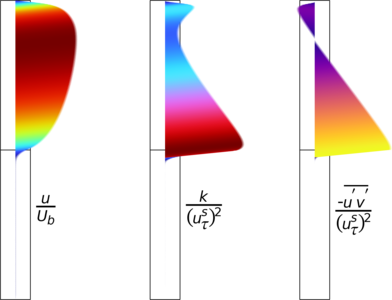
This setup demonstrates how the characteristics of turbulent flow in a channel are modified by the presence of an adjacent porous region. Asymmetric velocity profiles, higher turbulence levels, and higher friction coefficients both at the solid wall and the fluid-porous interface are ... Per saperne di più
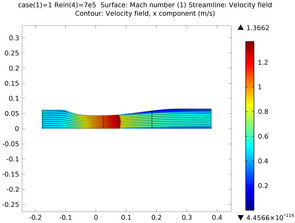
In this model the high speed turbulent gas flow in a converging and diverging nozzle is modeled using the High Mach Number Flow interface. The diffuser is transonic in the sense that the flow at the inlet is subsonic, but due to the contraction and the low outlet pressure, the flow ... Per saperne di più

Circulating fluidized beds are widely used in the food & beverage, pharmaceutical, chemical, and energy industries to achieve efficient contact between solid and fluid reactants. This model visualizes how a circulating fluidized bed operates. In the model, the dispersed phase, which ... Per saperne di più


