
La Galleria delle Applicazioni raccoglie un'ampia varietà di tutorial e di app dimostrative realizzati con COMSOL Multiphysics in diversi ambiti applicativi, inclusi quelli elettrico, meccanico, fluidico e chimico. E' possibile scaricare i file dei modelli e delle app demo pronti all'uso e le istruzioni step-by-step per costruirli, e utilizzarli come punto di partenza per le proprie simulazioni.
Lo strumento di Ricerca Rapida permette di trovare i modelli che si riferiscono alla propria area di interesse.
Si noti che molti degli esempi qui presentati sono accessibili anche tramite le Librerie delle Applicazioni incorporate nel software COMSOL Multiphysics® e disponibili dal menu File.

This model compares the numerical and analytical solutions for the capacitance matrix of two non-concentric spheres. It also illustrates the relation between the Maxwell capacitance matrix and the mutual capacitance matrix. Learn more about this model in the blog post "How to Calculate ... Per saperne di più

The design of antireflective coating plays an important role to increase the transmission of the infrared light that propagates through optical structures such as lens and windows. In this model, we showcase how different bulk structures such as Si and CZT that has the bulk ... Per saperne di più
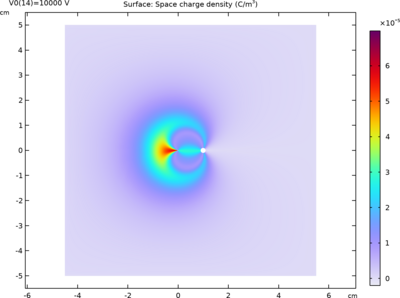
This model utilizes a continuation solver to efficiently compute the current–voltage characteristics of a corona discharge generated by a wire-to-wire configuration. It provides a flexible framework that can be easily adapted to study other discharge configurations and types. Per saperne di più

The example shows how to generate a discharge model from the Reaction Engineering interface with a self-defined discharge chemistry. It reproduces the library model 127181 (Double-Headed Streamer in Parallel-Plate Electrodes). Per saperne di più
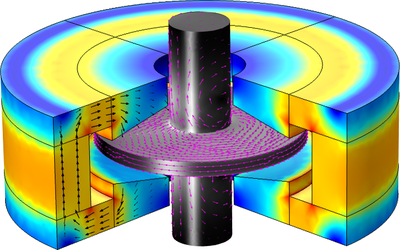
This model illustrates the working principle of an axial homopolar induction bearing. An electrically conducting rotor rotating in a magnetic field produced by a permanent magnets induces eddy currents on the conducting rotor. The eddy currents, in turn, produce a magnetic field that ... Per saperne di più

This model demonstrates how the sun causes 1.75 arcseconds of deflection for rays grazing the sun's surface as observed from the earth. Einstein predicted this value after refining his theory of relativity during World War I. Per saperne di più

This example simulates Trichel pulses produced by negative corona discharge under a point-to-plate configuration. The electron density and the electric field are obtained, as well as the discharge current. The discharge current clearly shows the pulsating characters. Each current pulse ... Per saperne di più

This model demonstrates how to find the optimal size and position of a water pipe in an air chamber, so that the energy absorption in the water is maximized. The objective is implemented as a constraint, so that the optimization terminates, when the desired performance is achieved. Per saperne di più

A magnetic diaphragm is a flexible, thin structure that interacts with magnetic fields to perform mechanical or sensing functions. When subjected to an external magnetic field, the diaphragm deforms due to magnetomechanical interactions, converting magnetic energy into mechanical ... Per saperne di più

This model simulates the propagation of a double-headed streamer in nitrogen at atmospheric pressure. Initially, electron-positive ion clusters were introduced between two parallel electrodes, subjecting the gas to a strong background electric field of 52 kV/cm. Subsequently, both the ... Per saperne di più


