
La Galleria delle Applicazioni raccoglie un'ampia varietà di tutorial e di app dimostrative realizzati con COMSOL Multiphysics in diversi ambiti applicativi, inclusi quelli elettrico, meccanico, fluidico e chimico. E' possibile scaricare i file dei modelli e delle app demo pronti all'uso e le istruzioni step-by-step per costruirli, e utilizzarli come punto di partenza per le proprie simulazioni.
Lo strumento di Ricerca Rapida permette di trovare i modelli che si riferiscono alla propria area di interesse.
Si noti che molti degli esempi qui presentati sono accessibili anche tramite le Librerie delle Applicazioni incorporate nel software COMSOL Multiphysics® e disponibili dal menu File.

An evanescent mode cavity filter can be realized by adding a structure inside of the cavity. This structure changes the resonant frequency lower than the dominant mode of the unfilled cavity. A piezo actuator is used to control the size of a small air gap which provides the tunability of ... Per saperne di più

Experiments on dry and wet soil samples are performed to understand their behavior under different loading conditions. In this example, the Extended Barcelona Basic (BBMx) soil model is used to simulate the wetting and drying paths in partially saturated soil samples under cyclic ... Per saperne di più

Ferroelectric materials exhibit nonlinear polarization behavior such as hysteresis and saturation at large applied electric fields. Many piezoelectric materials are ferroelectric. This model analyzes a simple actuator made of PZT piezoelectric ceramic material, which is subjected to ... Per saperne di più

The Keck Telescope is a 10 meter diameter telescope with a Ritchey-Chretien optical design. It is noted for being one of the first large optical telescopes to utilize a lightweight segmented primary mirror. This tutorial demonstrates how to use built-in polygonal mirrors from the COMSOL ... Per saperne di più

In a reciprocating piston engine, the connecting rods are subjected to high cyclic stresses that increase with engine speed. Because failure of a critical component can lead to failure of the engine, fatigue life is an important consideration in the design of these components. In this ... Per saperne di più
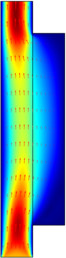
This is a tutorial model of the coupling between flow of a fluid in an open channel and a porous block attached to one of the channel walls. The flow is described by the Navier-Stokes equation in the free region and a Forchheimer-corrected version of the Brinkman equations in the porous ... Per saperne di più
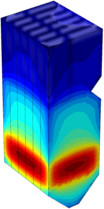
This model uses the discrete-ordinates method (DOM) to analyze the radiative heat transfer in a utility boiler with internal obstacles. DOM is one of the most useful radiation models for prediction of radiative heat fluxes on the furnace walls of a combustion chamber. With this model, ... Per saperne di più

This model illustrates the dynamics of a car door assembly during a slam event. The system consists of a car body, a door, and rubber seals. Contact pairs are defined between the car body, rubber seals, and the door. The rubber seal is modeled using a hyperelastic material model. A ... Per saperne di più
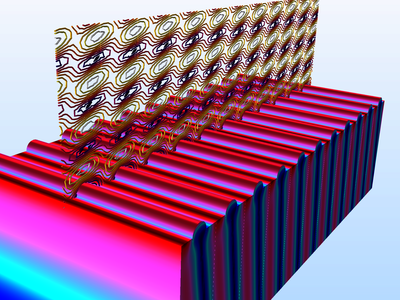
Surface plasmon-based circuits are being used in applications such as plasmonic chips, light generation, and nanolithography. The Plasmonic Wire Grating Analyzer application computes the coefficients of refraction, specular reflection, and first-order diffraction as functions of the ... Per saperne di più
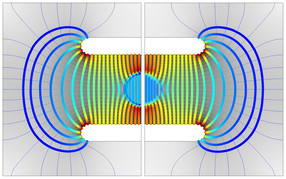
The dielectric shielding boundary condition is meant to approximate a thin layer of material with high relative permittivity compared to its surroundings. This boundary condition is available for electrostatic field modeling. This example compares the dielectric shielding boundary ... Per saperne di più


