
La Galleria delle Applicazioni raccoglie un'ampia varietà di tutorial e di app dimostrative realizzati con COMSOL Multiphysics in diversi ambiti applicativi, inclusi quelli elettrico, meccanico, fluidico e chimico. E' possibile scaricare i file dei modelli e delle app demo pronti all'uso e le istruzioni step-by-step per costruirli, e utilizzarli come punto di partenza per le proprie simulazioni.
Lo strumento di Ricerca Rapida permette di trovare i modelli che si riferiscono alla propria area di interesse.
Si noti che molti degli esempi qui presentati sono accessibili anche tramite le Librerie delle Applicazioni incorporate nel software COMSOL Multiphysics® e disponibili dal menu File.

This model illustrates how to perform prestressed eigenfrequency and frequency response analyses in a contact problem. A circular plate is squeezed between two thicker plates. The peak of the prestressed frequency response analysis is compared with the prestressed eigenfrequencies as ... Per saperne di più

The mass of an aluminum beam is minimized subject to a displacement constraint and a distributed load. The problem is solved using topology optimization with milling constraints. Per saperne di più

This tutorial model demonstrates the use of the Moisture Flow coupling node to account for the Stefan flow in moist air, over an evaporation surface. The effects on the velocity field and vapor concentration are presented with different ambient temperature conditions. Per saperne di più

This model illustrates the charge/discharge control of a Lithium-Ion battery in a Simulink® simulation. Per saperne di più
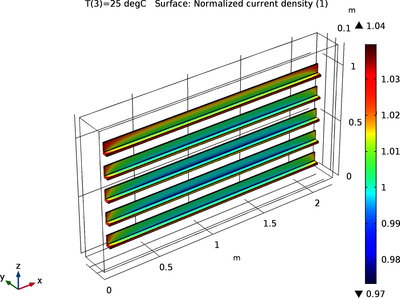
When anodizing aluminum, the surface is electrochemically altered to form an abrasive and corrosion-resistive Al2O3 film. The electrode kinetics during the process are only marginally affected as the oxide layer grows, so a stationary analysis of the current distribution is sufficient to ... Per saperne di più

This example minimizes the mass of a bracket that is synchronized from SOLIDWORKS® via the LiveLink™ interface. There are limits both for the lowest natural frequency, and for the maximum stress in a static load case. The size and position for a number of geometrical features ... Per saperne di più

In this example, a spring-loaded valve-opening mechanism consisting of a rocker arm and a radial cam is studied. All of the system components are modeled as rigid and are connected through prismatic, hinge, and slot joints. The cam-follower connection as well as other joint connections ... Per saperne di più

A benchmark model for the fatigue module. A cylindrical test is subjected to non-proportional loading. Three stress based models: Findley, Matake, Normal stress, are compared to analytical values and to each other. The non-smooth behavior of the Matake model is captured and discussed. Per saperne di più
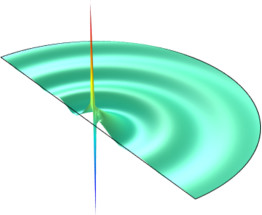
We have all noticed the Doppler effect when an ambulance passes by with its sirens blaring. The siren’s pitch suddenly drops the moment the ambulance starts moving away from you. Another effect you can notice is how the siren’s sound is very loud when nearby, but as soon as the ... Per saperne di più

The thin low permittivity gap boundary condition is meant to approximate a thin layer of material with low relative permittivity compared to its surroundings. This boundary condition is available for electrostatic field modeling. This example compares the thin low permittivity gap ... Per saperne di più


