
La Galleria delle Applicazioni raccoglie un'ampia varietà di tutorial e di app dimostrative realizzati con COMSOL Multiphysics in diversi ambiti applicativi, inclusi quelli elettrico, meccanico, fluidico e chimico. E' possibile scaricare i file dei modelli e delle app demo pronti all'uso e le istruzioni step-by-step per costruirli, e utilizzarli come punto di partenza per le proprie simulazioni.
Lo strumento di Ricerca Rapida permette di trovare i modelli che si riferiscono alla propria area di interesse.
Si noti che molti degli esempi qui presentati sono accessibili anche tramite le Librerie delle Applicazioni incorporate nel software COMSOL Multiphysics® e disponibili dal menu File.

This model simulates the velocity of the ionic wind generated by a wire-to-wire corona discharge. Ionic wind, created by the movement of charged particles in an electric field, can be harnessed for various applications, including cooling electronic components and enhancing heat ... Per saperne di più

Cryer's problem is a three-dimensional consolidation benchmark. A porous sphere is subjected to a uniform boundary pressure. The pore pressure at the center of the sphere rises due to the Mandel-Cryer effect that is captured by a two-way coupling between Darcy's law and solid mechanics. Per saperne di più

This model computes the fundamental eigenfrequency and eigenmode for a tuning fork that is synchronized from Solid Edge® via the LiveLink™ interface. The length of the fork is then optimized so that the tuning fork sounds the note A, 440 Hz. Per saperne di più

This model illustrates the working principle of a passive electrodynamic bearing. An electrically conducting rotor rotating in a magnetic field produced by a permanent magnets induces eddy currents on the conducting rotor. The eddy currents, in turn, produce a magnetic field that opposes ... Per saperne di più

This model computes the fundamental eigenfrequency and eigenmode for a tuning fork that is synchronized from SOLIDWORKS® via the LiveLink™ interface. The length of the fork is then optimized so that the tuning fork sounds the note A, 440 Hz. Per saperne di più
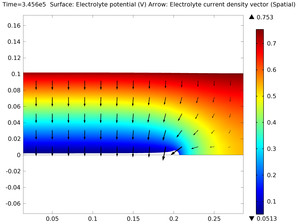
This example shows how to model secondary current distribution and electrode growth with a moving geometry. To avoid numerical instabilities, a seed layer is introduced in the initial geometry to obtain a right angle at the edge between the growing electrode and the insulator. Per saperne di più

This tutorial demonstrates a full electro-vibroacoustic analysis of a conceptual electrostatic speaker driver, composed of thin conducting plastic diaphragm residing between two perforated metal sheets called grids or stators. When an audio signal is applied to the grids (out of phase), ... Per saperne di più
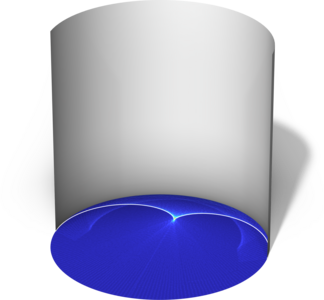
This model demonstrates the caustic effect produced by a cylindrical mirror. It highlights the advantages of the forward ray shooting method when modeling specular reflections from an external radiation source with the Surface-to-Surface Radiation interface. Per saperne di più

This small tutorial model studies energy conservation in a small conceptual test setup. The model has an inlet and outlet (modeled using ports) and a Helmholtz resonator with a very narrow neck. The acoustics in the narrow neck are modeled with Thermoviscous Acoustic for a detailed ... Per saperne di più
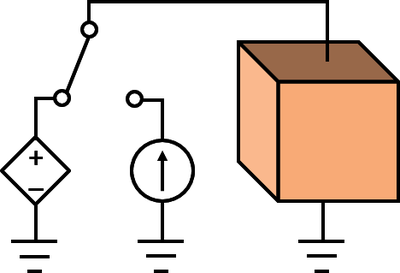
This example exemplifies how to model the switching between current and voltage excitations in Terminal boundary conditions. A more detailed description of the phenomenon and the modeling process can be seen in the blog post "Control Current and Voltage Sources with the AC/DC Module". Per saperne di più


