
La Galleria delle Applicazioni raccoglie un'ampia varietà di tutorial e di app dimostrative realizzati con COMSOL Multiphysics in diversi ambiti applicativi, inclusi quelli elettrico, meccanico, fluidico e chimico. E' possibile scaricare i file dei modelli e delle app demo pronti all'uso e le istruzioni step-by-step per costruirli, e utilizzarli come punto di partenza per le proprie simulazioni.
Lo strumento di Ricerca Rapida permette di trovare i modelli che si riferiscono alla propria area di interesse.
Si noti che molti degli esempi qui presentati sono accessibili anche tramite le Librerie delle Applicazioni incorporate nel software COMSOL Multiphysics® e disponibili dal menu File.

This tutorial demonstrates how to model the band-to-band tunneling across a p–n junction. The tunneling effect is imitated by defining the User-Defined Recombination domain feature which makes the electrons disappear from the conduction band on the n-side and holes disappear from the ... Per saperne di più

The problem of a plane wave scattering off a cylinder-shaped object suggests the use of the 2D axisymmetric formulation. This can save computation time and reduce the memory usage compared to the model in 3D space. This example demonstrates the use of the built-in plane wave expansion ... Per saperne di più

Modeling and simulation is useful for evaluating the feasibility of storing hydrogen underground. In this example of a geological formation, hydrogen is injected through an injection well at a rate of 1 kg/s over a period of 2 years, until it is ready to be extracted and discharged ... Per saperne di più
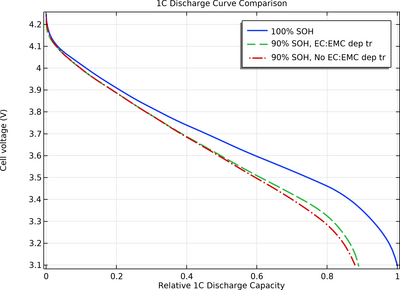
The liquid electrolyte in lithium-ion batteries (LIBs) typically consists of a lithium salt, such as LiPF6, dissolved in one or several solvents. Commercial LIBs commonly employ a mix of multiple hydrocarbon-based solvents along with additional additives. In an electrolyte consisting of ... Per saperne di più

A smoke exhaust duct in a building is analyzed. Radiation of a non-gray gas is accounted for with a Radiation in Participating Media interface and the Weighted Sum of Gray Gases Model (WSGG). The smoke exhaust duct consists of 25 mm plaster walls. Building codes require that the walls ... Per saperne di più
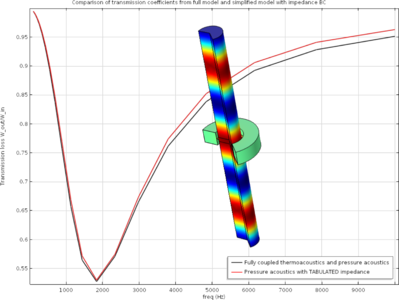
This application illustrates a modeling approach for deriving physically consistent simplified models in the Acoustics Module. The approach consists of converting complex sub-components to an impedance boundary condition and otherwise using simple acoustics throughout the COMSOL model. ... Per saperne di più

This tutorial demonstrates how to create domains for modeling inside and outside of an imported CAD assembly. You will also learn how to use the defeaturing tools for deleting details from the imported geometry. Per saperne di più

This single-phase induction motor model is used to compare with Testing Electromagnetic Analysis Method (TEAM) workshop problem 30. The Magnetic Fields physics interface is used to model the motor in the frequency domain at 60 Hz. The Velocity (Lorentz Term) feature is used to model the ... Per saperne di più

This example demonstrates an app that utilizes the LiveLink™ interface for Inventor® to run simulations on CAD designs. Per saperne di più
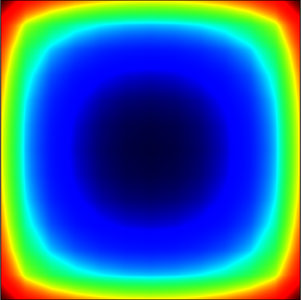
This model is used on "Heat Transfer with Radiation in Participating Media and the Discrete Ordinates Method" to compare quadrature sets used in the method of discrete ordinates. The reference analytical solution of incident irradiation is obtained with 256 discrete directions. Errors in ... Per saperne di più


