
La Galleria delle Applicazioni raccoglie un'ampia varietà di tutorial e di app dimostrative realizzati con COMSOL Multiphysics in diversi ambiti applicativi, inclusi quelli elettrico, meccanico, fluidico e chimico. E' possibile scaricare i file dei modelli e delle app demo pronti all'uso e le istruzioni step-by-step per costruirli, e utilizzarli come punto di partenza per le proprie simulazioni.
Lo strumento di Ricerca Rapida permette di trovare i modelli che si riferiscono alla propria area di interesse.
Si noti che molti degli esempi qui presentati sono accessibili anche tramite le Librerie delle Applicazioni incorporate nel software COMSOL Multiphysics® e disponibili dal menu File.

For more than 50 years, it has been known that neutrally buoyant particles in a flow channel tend to converge to specific locations in the channel cross section. For a cylindrical pipe, or two parallel planes carrying a Poiseuille flow, the equilibrium position is about 0.6 times the ... Per saperne di più
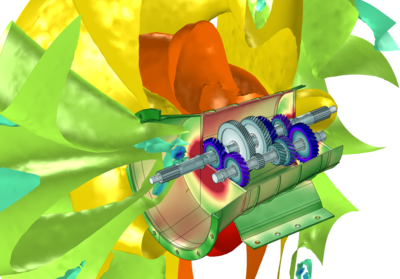
This example illustrates the modeling of vibration and noise in a 5-speed synchromesh gearbox of a manual transmission vehicle. A transient multibody analysis is performed to compute the gearbox vibration for the specified engine speed and external load. The normal acceleration of the ... Per saperne di più
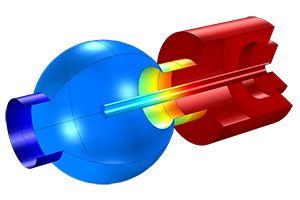
This model shows how to simulate the time-dependent adsorption and desorption of water in a vacuum system at low pressures. The water is introduced into the system when a gate valve to a load lock is opened and the subsequent migration and pumping of the water is modeled. Per saperne di più

This example shows how to set up a glacier flow model in principle, containing several important aspects of glacier modeling: The creation of the 2D geometry, the modeling of non-Newtonian flow, and the implementation of basal sliding. In this example, two different glacier types, a cold ... Per saperne di più

This model analyzes the electromagnetic, mechanical, and acoustical characteristics of the OWS-1943T-8CP (discontinued) speaker. Beside certain details, the geometry, material properties, and measurements are copyright by Ole Wolff. Starting from the geometry of the speaker, an ... Per saperne di più

Transport which is purely diffusive in nature can be modeled using a Brownian force. This model shows how to add such a force in the Particle Tracing for Fluid Flow physics interface. Particle diffusion in a fluid is modeled with the diffusion equation and the Particle Tracing for Fluid ... Per saperne di più
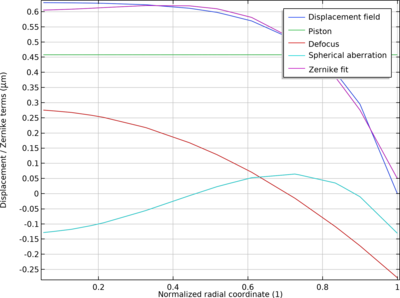
This tutorial shows how the displacement field of a deformed surface can be fit to a Zernike polynomial basis. The method of linear least-squares fitting is made significantly easier when fitting to an orthonormal basis, such as the Zernike polynomials on a circle. The displacement ... Per saperne di più

The multipole expansion is a powerful tool for analyzing electromagnetic waves scattered by small objects. In the expansion, the scattered field is represented as a superposition of the fields created by a finite set of point multipoles. Each point multipole is connected to a unique ... Per saperne di più

This model demonstrates how to compute the volumetric fluence rate in an ultraviolet (UV) reactor. The geometry is the annular fluid region surrounding a cylindrical lamp. The effect of reflection at the reactor walls on the radial fluence rate distribution is considered. Per saperne di più

The Hubble Space Telescope (HST) is an example of a standard Cassegrain telescope. The Conic Mirror On Axis 3D part from the COMSOL part library is used to construct the HST Ritchey-Chretien geometry. Multiple release features are used to generate on and off-axis ray and spot diagrams. Per saperne di più


