
La Galleria delle Applicazioni raccoglie un'ampia varietà di tutorial e di app dimostrative realizzati con COMSOL Multiphysics in diversi ambiti applicativi, inclusi quelli elettrico, meccanico, fluidico e chimico. E' possibile scaricare i file dei modelli e delle app demo pronti all'uso e le istruzioni step-by-step per costruirli, e utilizzarli come punto di partenza per le proprie simulazioni.
Lo strumento di Ricerca Rapida permette di trovare i modelli che si riferiscono alla propria area di interesse.
Si noti che molti degli esempi qui presentati sono accessibili anche tramite le Librerie delle Applicazioni incorporate nel software COMSOL Multiphysics® e disponibili dal menu File.

This tutorial studies the etching of silicon using an inductively coupled plasma reactor with an RF bias in a mixture of CF4/O2. The etching rate is computed along the wafer as a function of the RF bias voltage. Per saperne di più

This tutorial model shows how to set up a model of a pulsed capacitive discharge. The on pulse consists of 10 periods of excitation at 13.56MHz, followed by no excitation for 100 periods. The I-V characteristics, the electron density, temperature and plasma potential are studied. Per saperne di più
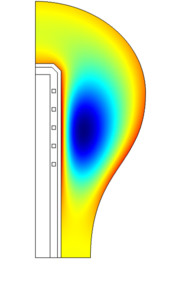
This model simulates an electrodeless lamp with argon/mercury chemistry. The low excitation threshold for mercury atoms means that even though the mercury is present in small concentrations, its behavior dominates. There is strong UV emission from the plasma at 185 nm and 253 nm. The UV ... Per saperne di più
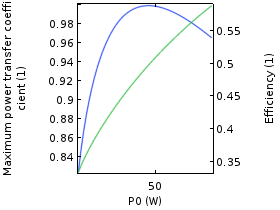
This tutorial drives a capacitively coupled plasma with an L-type matching network at high and low powers. At low power, where the harmonics in the current are low, prefect matching is obtained at the chosen power value. Sweeps over power, frequency, and pressure are performed and their ... Per saperne di più

This tutorial studies the deposition of amorphous silicon using an inductively coupled plasma reactor with a silane/argon gas mixture. It examines how the deposition rate varies across the wafer as a function of silane mole fraction and input power. Per saperne di più
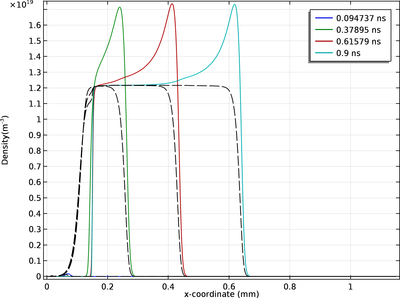
Streamers are transient filamentary electric discharges that can develop in a nonconducting background in the presence of an intense electric field. These discharges can attain high electron number density and consequently a high concentration of chemical active species that are relevant ... Per saperne di più

This tutorial model explores the behavior of a microwave plasma torch. The plasma is generated within a dielectric tube inserted in a rectangular waveguide. The simulation solves the coupled equations for plasma transport and heating, microwave electromagnetic fields, fluid flow, and ... Per saperne di più

Electron transport in low-temperature plasmas depends strongly on the electron energy distribution function (EEDF), which is often approximated as Maxwellian but is frequently nonequilibrium in reality. Incorporating nonequilibrium EEDF behavior into spatially dependent models often ... Per saperne di più
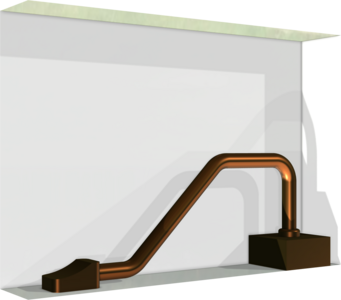
This model analyzes Joule heating and thermal expansion in a bond wire in an LED. Its purpose is to estimate the temperature increase and the resulting mechanical stresses in the bond wire due to thermal expansion. The magnitude of these stresses can be used to assess the risk of fatigue ... Per saperne di più
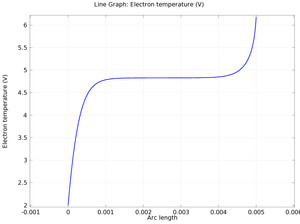
The Drift Diffusion interface solves a pair of reaction/advection/diffusion equations, one for the electron density and the other for the mean electron energy. This tutorial example computes the electron number density and mean electron energy in a drift tube. Electrons are released due ... Per saperne di più


