
In conformità con la nostra Quality Policy, COMSOL ha pubblicato una libreria con centinaia di esempi di modelli documentati che vengono regolarmente testati rispetto all'ultima versione del software COMSOL Multiphysics®, compresi i problemi di benchmark di ASME e NAFEMS, così come TEAM problems.
I nostri test di verifica e validazione (V&V) forniscono soluzioni sempre accurate che vengono confrontate con i risultati analitici e i dati di riferimento stabiliti. I modelli documentati qui sotto fanno parte delle Application Library integrate nel software COMSOL Multiphysics®. Includono inoltre valori di riferimento e fonti per un'ampia gamma di benchmark, così come istruzioni passo-passo per riprodurre i risultati sul proprio computer. Questi modelli possono essere usati non solo per documentare l'impegno nella garanzia di qualità del software (SQA) e nella verifica del codice numerico (NCV), ma anche come parte di un programma di formazione interno.
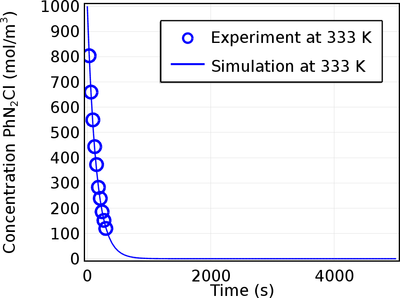
This example shows how to use the Parameter Estimation and Experiment features in the Reaction Engineering interface for optimization with multiple experimental data input files. The application finds the Arrhenius parameters of a first order reaction where Benzene diazonium chloride ... Per saperne di più
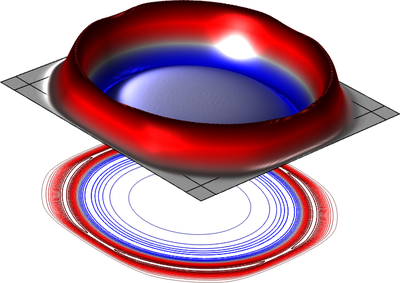
This tutorial simulates a standard test and benchmark model for perfectly matched layers (PMLs) as absorbing boundary conditions in the time domain. It involves the propagation of a transient Gaussian pulse with no flow. The Pressure Acoustics, Transient interface is used together with ... Per saperne di più
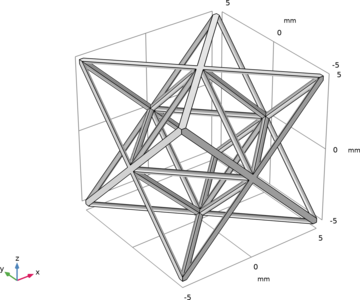
Lattice structures enable the creation of advanced materials for additive manufacturing with customized mechanical properties. At the macroscopic level, these structures can be modeled as homogeneous materials using homogenization techniques that determine their effective material ... Per saperne di più

Capacitively coupled RF discharges can operate in two distinct regimes depending on the discharge power. In the low power regime, known as the alpha regime, the electric field oscillation is responsible to heat and create electrons. In the high power regime, known as gamma regime, the ... Per saperne di più

This is a benchmark model for the linearized Euler interface of the Acoustics Module. The model is from the NASA "Fourth Computational Aeroacoustics (CAA) Workshop on Benchmark Problems (2004)". The model results are compared to an analytical solution by Agarwal et al. (AIAA Vol. 42, No. ... Per saperne di più
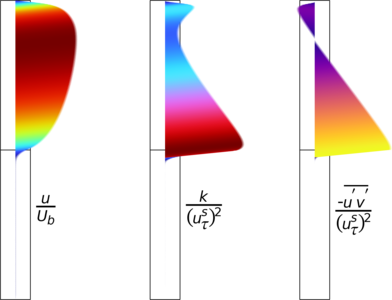
This setup demonstrates how the characteristics of turbulent flow in a channel are modified by the presence of an adjacent porous region. Asymmetric velocity profiles, higher turbulence levels, and higher friction coefficients both at the solid wall and the fluid-porous interface are ... Per saperne di più
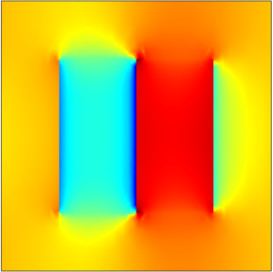
Magnetotellurics is a method for estimating the resistivity profile of the Earth's subsurface using the natural electromagnetic source provided by the ionosphere. This model was defined by Zhdanov et al. in a study published in 1997. In this article, various scientific groups compared ... Per saperne di più
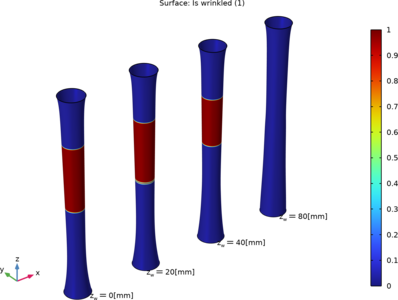
In this example, wrinkling is studied in a cylindrical membrane of nonuniform thickness under axial and pressure loading. The membrane is modeled as an incompressible Mooney–Rivlin material. During axial stretching, certain portions of the membrane undergo wrinkling; however, the ... Per saperne di più

It is more difficult to generate laser emissions in the short-wavelength part of the visible and near visible part of the electromagnetic spectrum than in the long-wavelength part. Nonlinear frequency mixing makes it easier to generate new short wavelengths from existing laser ... Per saperne di più

This example illustrates the use of the Maxwell-Stefan diffusion model available with the Transport of Concentrated Species interface. It models multicomponent gas-phase diffusion in a Stefan tube in 1D. In this case, it is a liquid mixture of acetone and methanol that evaporates into ... Per saperne di più


