
La Galleria delle Applicazioni raccoglie un'ampia varietà di tutorial e di app dimostrative realizzati con COMSOL Multiphysics in diversi ambiti applicativi, inclusi quelli elettrico, meccanico, fluidico e chimico. E' possibile scaricare i file dei modelli e delle app demo pronti all'uso e le istruzioni step-by-step per costruirli, e utilizzarli come punto di partenza per le proprie simulazioni.
Lo strumento di Ricerca Rapida permette di trovare i modelli che si riferiscono alla propria area di interesse.
Si noti che molti degli esempi qui presentati sono accessibili anche tramite le Librerie delle Applicazioni incorporate nel software COMSOL Multiphysics® e disponibili dal menu File.

This tutorial model shows how a user-defined coordinate system can be used to create any type of directional polarization of a piezoelectric material. Results are shown for the case of radial polarization of a piezoelectric disk. The piezoelectric material is PZT-5H. The example shows a ... Per saperne di più

The design of antireflective coating plays an important role to increase the transmission of the infrared light that propagates through optical structures such as lens and windows. In this model, we showcase how different bulk structures such as Si and CZT that has the bulk ... Per saperne di più

This model presents the transient modeling of a coaxial magnetic bearing using permanent magnets. The coaxial magnetic bearing is advantageous over the conventional mechanical gear mainly because of minimum noise, maintenance free operation, overload protection and physical isolation ... Per saperne di più

The electrical insulation strength of gases is generally much lower than that of solids. Under normal operating conditions, electrical discharges—known as partial discharges—can occur in voids or cracks within a solid dielectric. This model simulates partial discharges in a spherical ... Per saperne di più

This model illustrates the working principle of a passive electrodynamic bearing. An electrically conducting rotor rotating in a magnetic field produced by a permanent magnets induces eddy currents on the conducting rotor. The eddy currents, in turn, produce a magnetic field that opposes ... Per saperne di più
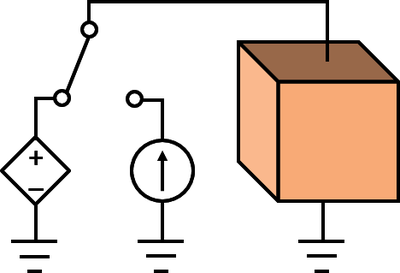
This example exemplifies how to model the switching between current and voltage excitations in Terminal boundary conditions. A more detailed description of the phenomenon and the modeling process can be seen in the blog post "Control Current and Voltage Sources with the AC/DC Module". Per saperne di più

This tutorial demonstrates a full electro-vibroacoustic analysis of a conceptual electrostatic speaker driver, composed of thin conducting plastic diaphragm residing between two perforated metal sheets called grids or stators. When an audio signal is applied to the grids (out of phase), ... Per saperne di più
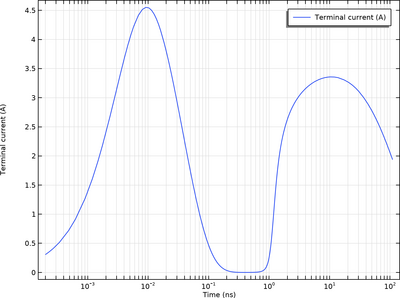
This model shows how to simulate the complex discharge physics behind the well-known electrostatic discharge (ESD). The model connects the Electrical Discharge interface with the Circuit interface to simulate how ESD current is generated when a human hand touches metal. Per saperne di più

Light Detection And Ranging (LIDAR) is used extensively in self-driving cars to perform the quantitative ranging of the surroundings obstacles. The LIDAR system consists of a laser beam which gets broadened using a MEMS mirror with a particular horizontal and vertical field of view ... Per saperne di più

This model shows that the frequency response, i.e., admittance curve, of the SAW unit cell with IDT is in good agreement with the series resonance & antiresonance frequencies obtained from the eigenfrequency studies in the tutorial Surface Acoustic Wave Velocity Calculations from a ... Per saperne di più


